
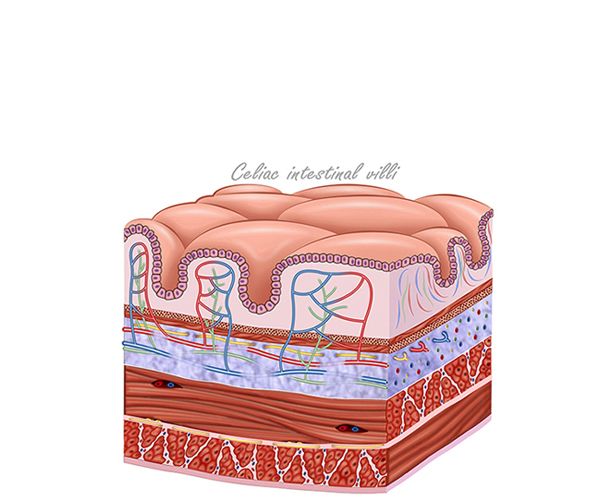



Villous atrophy in celiac disease. This image shows a comparison between normal intestinal villi and atrophied villi in celiac disease. In this illustration, flattened and reduced structures are visible. Moreover, the figure highlights decreased absorption surface. Together, these changes impair intestinal function.
Villous atrophy in celiac disease is a hallmark of this autoimmune condition. Additionally, intestinal villi are finger-like projections lining the small intestine. However, in this disease, these structures progressively deteriorate. As a result, nutrient absorption is impaired.
The main function of villi is to absorb vitamins and nutrients. Nevertheless, when atrophy occurs, this function decreases significantly. Furthermore, reduced surface area limits nutrient uptake. Consequently, deficiencies develop.
The origin is linked to an immune response to gluten. Moreover, gluten intake triggers inflammation in the intestinal lining. Therefore, the immune system damages the villi. Additionally, this process continues without dietary control.
Nutrient transport is significantly affected. In a healthy intestine, nutrients are efficiently absorbed. In contrast, villous atrophy leads to poor absorption. As a result, anemia, weight loss, and fatigue may occur.
Key processes include chronic inflammation, autoimmune response, and villi destruction. Moreover, symptoms include diarrhea, bloating, and digestive discomfort. However, some individuals may have mild symptoms.
Regulation requires early diagnosis. Additionally, serological tests and a biopsy are essential. Furthermore, treatment involves a strict gluten-free diet. Together, these measures allow recovery.
In conclusion, villous atrophy in celiac disease is a key indicator of intestinal damage. With proper management, intestinal function can improve.