
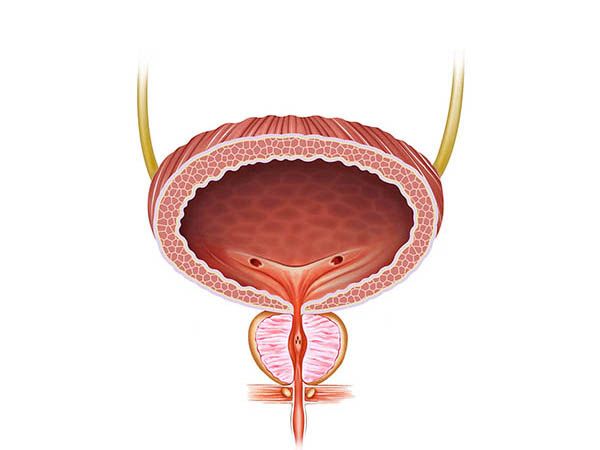



Male bladder anatomy. In this illustration, we can observe the male urinary bladder, a hollow muscular organ with a balloon-like shape. Moreover, this image shows its location within the pelvis and its relationship with nearby structures. Likewise, this representation highlights elements such as the prostate, which surrounds the urethra near the bladder neck.
The male bladder is an essential part of the urinary system. First, it is located in the pelvic cavity, behind the pubic bone. In addition, it is supported by ligaments that connect it to the pelvic bones and surrounding organs. Therefore, it maintains a stable position within the body.
Next, the bladder wall is composed of the detrusor muscle. This muscle allows the bladder to expand as it fills with urine. Furthermore, it contracts during urination. As a result, it enables efficient urine expulsion.
In addition, the bladder receives urine from the ureters. Then, it stores urine temporarily until an appropriate volume is reached. Afterward, urine is expelled through the urethra.
On the other hand, a distinctive feature of the male bladder is the presence of the prostate. Indeed, this gland surrounds the urethra at its initial portion. Furthermore, it plays a role in the male reproductive system. As a result, its size can influence urinary flow.
Moreover, the male bladder is anatomically related to structures such as the seminal vesicles and rectum. In this way, it is part of an integrated system.
Furthermore, urination is controlled by the nervous system. Consequently, muscle contraction and relaxation are coordinated.
In summary, male bladder anatomy reflects its function in urine storage and elimination. Additionally, its relationship with the prostate distinguishes it anatomically. Therefore, it is essential for urinary and reproductive health.