
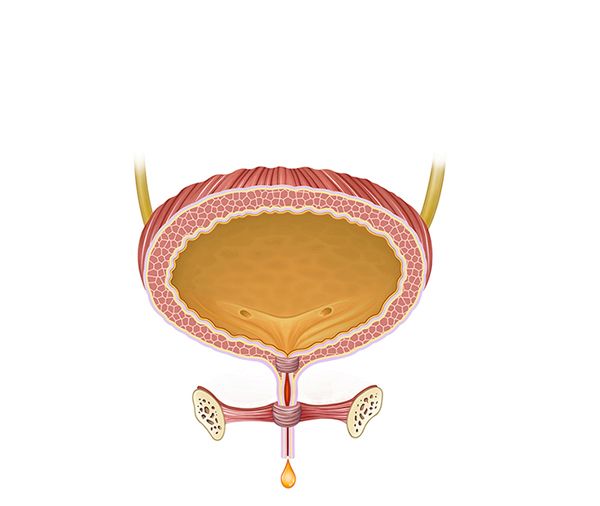



The overflow incontinence is shown in this anatomical illustration focused on the bladder and lower urinary system. In the image, a distended bladder filled with urine is visible. Moreover, incomplete bladder emptying is illustrated. Furthermore, involuntary urine leakage is shown. On the other hand, functional alterations are clearly identified.
In this case, the overflow incontinence is the involuntary loss of urine due to incomplete bladder emptying. Additionally, it is characterized by chronic urinary retention. Consequently, the bladder becomes overfilled. Likewise, increased volume leads to leakage. For example, urine may leak continuously or intermittently.
From a pathophysiological perspective, the bladder loses its ability to contract effectively. Moreover, urinary tract obstruction may be present. Furthermore, this prevents normal urine flow. On the other hand, intravesical pressure progressively increases. Consequently, overflow leakage occurs.
Regarding symptoms, the overflow incontinence often presents with continuous dribbling. However, a sensation of incomplete emptying may also occur. Additionally, patients may have difficulty initiating urination. For example, abdominal distension may be present. Likewise, high post-void residual volume is common.
On the other hand, causes include obstructions such as prostate enlargement. Consequently, neurological disorders may also contribute. Moreover, detrusor muscle dysfunction plays a role. Furthermore, these factors worsen the condition. Overall, they determine severity.
Diagnosis of the overflow incontinence is based on clinical history and additional tests. Moreover, post-void residual volume is measured. Furthermore, imaging studies may be used. Consequently, the underlying cause is identified. On the other hand, treatment is guided.
Finally, treatment depends on the cause. For instance, relieving obstruction may be necessary. However, catheters or medications may also be used. Additionally, bladder management strategies are recommended. In conclusion, proper care improves symptoms.