
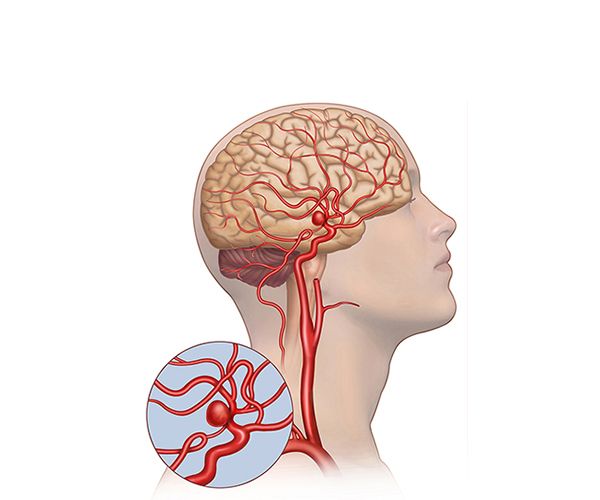



Cerebral arterial aneurysm. This image shows an abnormal dilation in a cerebral artery, forming a bulging area due to weakening of the vessel wall. In this representation, the brain, cerebral arteries, vascular wall, aneurysmal sac, and blood flow are identified. These structures ensure proper brain perfusion. Moreover, this image illustrates localized arterial expansion. Additionally, pressure on surrounding tissues is observed. Overall, this representation helps explain this vascular condition.
The cerebral arterial aneurysm has an altered function in cerebral circulation. Moreover, under normal conditions, arteries maintain structural integrity. Additionally, they allow continuous blood flow. Furthermore, they ensure oxygen supply to the brain.
On the other hand, this condition results from weakening of the arterial wall. It may be associated with hypertension. Moreover, genetic factors may influence its development. Additionally, aging may contribute.
Transport of blood occurs through cerebral arteries. For example, oxygen reaches neurons via circulation. Moreover, when an aneurysm is present, the vessel wall expands. Additionally, rupture risk increases.
Key processes include vascular dilation and pressure on nearby structures. Moreover, a headache may appear as a symptom. However, many cases are asymptomatic. Additionally, rupture can cause hemorrhage.
Regulation depends on vascular and systemic factors. Moreover, blood pressure control is essential. Additionally, medical monitoring helps detect changes. Furthermore, treatment may be surgical or endovascular.
As a result, rupture represents a serious emergency. Additionally, it may cause a brain hemorrhage. Moreover, timely intervention improves prognosis.
Therefore, the cerebral arterial aneurysm is a critical condition. In conclusion, it requires medical monitoring to prevent life-threatening complications.