
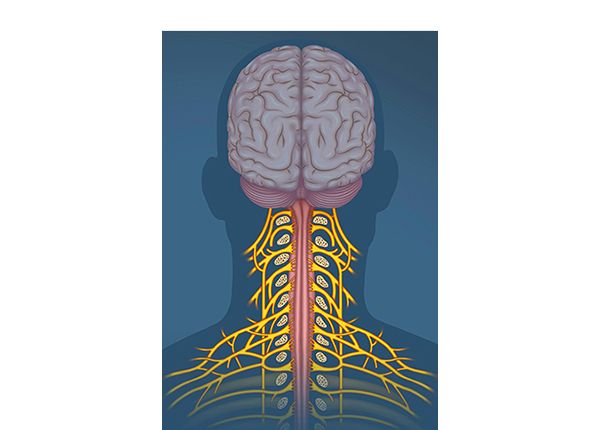



The cervical spinal nerves represent an important component of the peripheral nervous system. These nerves originate from the spinal cord in the cervical region of the vertebral column. In the human body there are eight pairs of cervical nerves, identified as C1 through C8. Each nerve exits the spinal cord through openings between the cervical vertebrae.
These neural pathways play a key role in transmitting information between the central nervous system and several regions of the body. Through these connections, motor signals travel to muscles, while sensory signals carry information from the skin and tissues back toward the brain.
Cervical nerves are responsible for supplying many structures in the upper part of the body. In particular, they provide motor control and sensory input to the neck, shoulders, arms, and hands. Through this communication network, the brain can coordinate the movement of the upper limbs while receiving sensory information from these areas.
Furthermore, these nerves contribute to the formation of two major neural networks known as the cervical plexus and the brachial plexus. The cervical plexus is mainly formed by nerve roots C1 to C4 and supplies structures in the neck region. One of its most important branches is the phrenic nerve, which arises primarily from roots C3, C4, and C5. This nerve plays a crucial role in breathing because it controls the movement of the diaphragm.
In contrast, nerve roots C5 through C8 contribute to the brachial plexus, a complex network responsible for innervating the upper limbs. From this plexus arise several major nerves that control the muscles of the shoulder, arm, forearm, and hand.
Overall, the cervical spinal nerves form part of a complex communication network linking the brain and spinal cord with the upper regions of the body. Through this organization, the nervous system can coordinate precise movements, maintain sensory perception in the upper limbs, and regulate essential functions such as breathing.